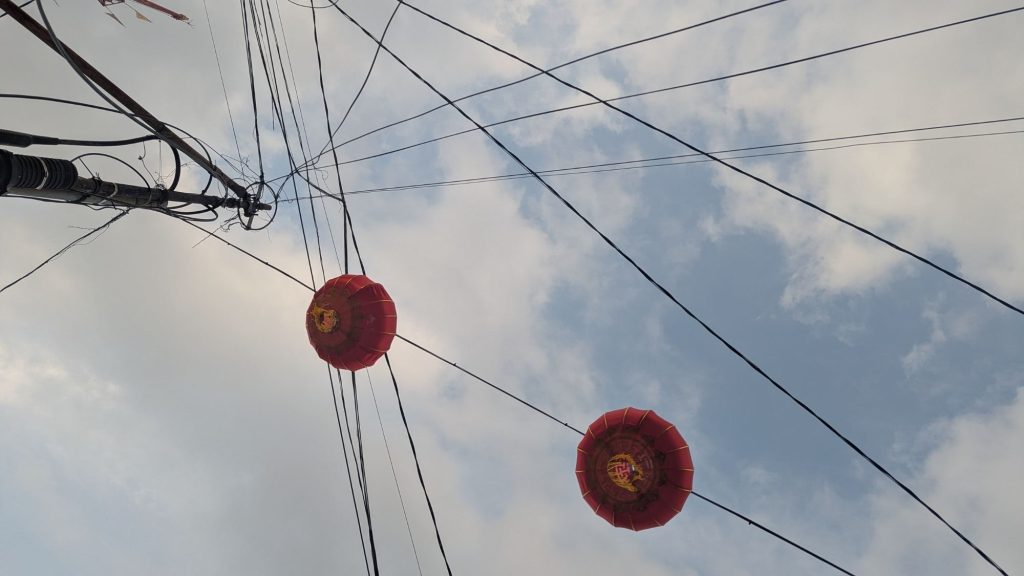
My family rarely plans for Lunar New Year. It’s not part of our household tradition, from which I often say to friends that we’re more Christian than Chinese even when one of my core memories is about fifth-grade peers at school bringing red envelopes (one of them said she got almost one million rupiah from his aunts and uncles; that was a lot of money in 2001). We don’t reserve a table at a Chinese food restaurant. Mom doesn’t prepare more than usual. My siblings and I don’t bring home fruits or hampers. We don’t prepare red envelopes, rarely receive them. No planned celebration.
This not-planning is so consistent that I booked a train ticket to Semarang a few days after the New Year’s day this year. In my head, I would spend the holidays in Jakarta, just laying down and ordering some food. But my younger brother suddenly decided to drive and asked if I wanted to join him. And so we went back home without telling our parents; he said, “It’s a surprise.” Our surprise visit came with the expected: no food at home and we decided to have dinner at a quiet okay hotpot place because most Chinese restaurants were fully occupied. We closed the day with a decent family conversation about mortgage, debt, and health and financial struggle, then my dad prayed wishing for strength and kindness. We don’t celebrate. We get things real and spiritual. Or maybe we don’t really have the cultural means to celebrate the day as part of our Chineseness. Again, perhaps we’re too Christian to be Chinese, or too secular and uprooted to be one.
This morning, I pondered once more on my stillness to deal with this whole stuff of being/not being Chinese. It’s not that I’m confused about my ethnic and history-based identity (or maybe I am, who knows, I’m not self-psychoanalyzing). It’s more about my interest in the aesthetics of such searching—an interest that makes me appreciative yet skeptical to most projects under the umbrella of Chinese-Indonesian identity and history.
That is how, first, the last time I wrote a personal anecdote about Lunar New Year was in 2020, during the early Covid Pandemic, when I was still in the United States and doing research on Tjamboek Berdoeri/Kwee Thiam Tjing, a pseudonymous Chinese-Indonesian writer. After that, I’m too fixated with the obscurity of one’s name and authentic identity. The academic and personal search of proper name disinterest me; and personal essays and visual projects about Chinese-Indonesian(ness) unmove me.
That is how, second, my last review of a novel about Chinese-Indonesian woman story is a criticism against nationalist minority and middle-class grip of ideas that wealth has nothing to do with identity crisis. The aesthetics of searching Chinese(-Indonesian) identity, I think, rarely answer the ambiguity of self-rejection and internalized disposition coming from the troubling encounters of various ethnics, races, classes, sexualities, and bodily abilities. Keep talking about intersectionality in art/academic cultural discourse, yet how to exercise and rehearse the practices of loosening the grips?
Lunar New Year is not the only time when the somber and angry part of me flared up, rejecting the constant discourse of (re)Sinicization that I don’t want to participate in. It comes to me when I see art exhibitions, public discussions, books publication. I’m not hard to please, simply suspicious. I flip flop my ways of seeing, trying to see things from multiple angles, that perhaps with time and knowledge, I would change my argument, my attitude, my lack of fellow-like sentiment. Yet, it’s still here, not growing, but keep bothering me. I’m too drown in the existential grief of losing parental archives that I cannot flow with the memorial course of historiography. I refuse to make my intellectual project of reading the aesthetics too personalized, but the so-called “Chinese question” is always personal for me. I’ve argued with colleagues on how I think remembering is imbued by social and economic status. I prefer to stay in the zone of unbelonging where I can think harder about un/making identity more through the absence than through the abundance of attached feelings.
Detachment as a method—and not as a predisposition—is where I also feel distant from the field of “sejarah Tionghoa” and the derivatives, but am still allured to a history about movements and ideas formation within which people make do with whatever tools they have at hand including by using “Tionghoa” as a category. In exercising this method, personal history (and pieces of writing born from it) can be an exercise of contempt and dissatisfaction of present progress and problems, a technology of disordering that helps us (or at least me) to confront the discomfort of being attached to a historical category that have become aesthetic subjects of sexual, social, and political desire. This requires us to deject the familiar narrative of what counts as “removed” history, to deal with both the material and metaphysical question of being, within which Tionghoa category becomes recognizable and maintainable.
It’s not easy, I know; and my adversity is not without a cost. I recently declined a then friend’s invitation for a Lunar New Year’s dinner at her house not because I dislike her or her cordial invitation (I mean, I enjoy her company and her mom’s meals). I just cannot not see her visible insistence behind our friendship, that I’m less a friend than a fellow “Christian Chindo queer” whom she could talk through, think with, and learn from. Similarly, I could not easily avoid this trap. Her family stories often brought me back to the early twentieth century texts I read. My complaint about Chinese-Indonesian oligarchs also went through her. We did sit down together and tried talking about this. I said to her that I’m having a hard time sustaining intimacy and friendship heavily based on trauma and relatability. “What do you want from me as a friend?” I asked. She could not give me an answer. I consoled myself that it’s completely fine for two Chindo queers to not be friend, although, escalated by my toxic traits, I preserve a deep remorse over my own incapacity to hold this friendship. Apparently what I need is not a clarity of intent but a respectful effort to know each other and build connection beyond familiarity. This makes me overthinking and intellectualizing the smallest parts of my daily interactions with her. I’m suspicious with rushed out intimacy based on “me too.” This is my burden to bear. No greatness in my history.
I come to understand better: no quick routine to deal with a mind-problem I make for myself. Likewise, I cannot celebrate Lunar New Year in a meticulous manner of holding tradition (whatever that means). As my dad does not hold his Chinese family name for the sake of survival, and my mom is often seen more “Chinese” due to her appearance (re: lighter skin) even when she’s not, as I refuse to be “cici-cici” nor I choose to be “koko-koko,” I keep training my body so it can always contain dualities and contradictions without crumbling down.
Dear friends, happy new year. I’m reclaiming this space of ambiguity.
 Nik Setiadarma