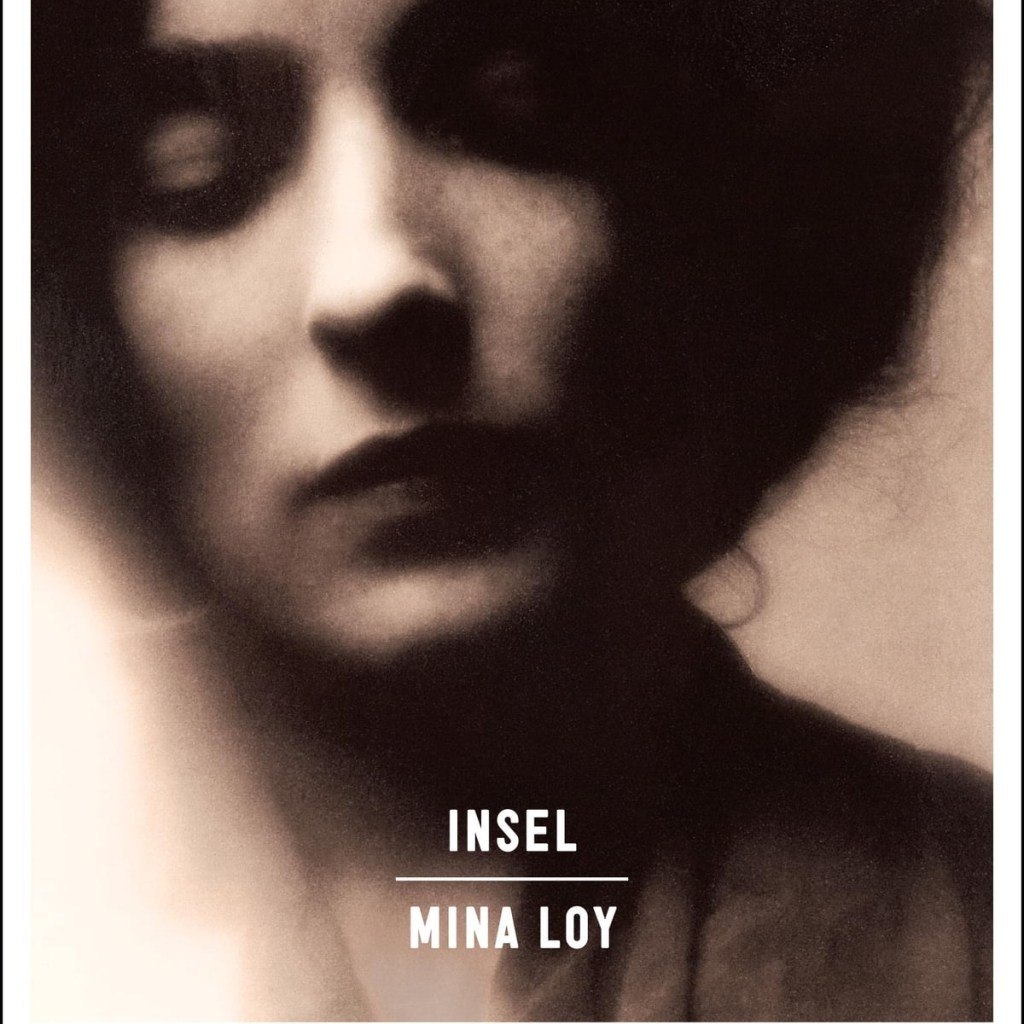
Paintings may allure loneliness. But how dare one is to confront? Mina Loy’s Insel begins with a moment of encountering a friendship (or not, I’m still unsure) with an artist. Narrated by Mrs. Jones, a middle-age woman who worked as a Paris representative of a New York art dealer, the novel is opened with a rather lively tone of her meeting with Insel, a German surrealist artist, and his work.
The man himself is just like that. He did not say anything in particular, but you felt you were in the room with an invisible will-o’-the-wisp, and that any moment it might light up. He’s the son, he said, of tiny working people and seems the most delicate and refined soul I’ve ever come across. He has an evening suit, but never an occasion to wear it, so he puts it on when he paints his pictures, first having meticulously cleaned everything in his studio. Now, I don’t mean he’s a delicate soul because he paints in evening dress—! That’s just one of his stories I remember. I shall probably find this quality exists only in my imagination because there’s something fundamentally black-magicky about the surrealists, and I feel that going in that direction, his face, that looks almost luminous from starvation, will turn out to be a death’s head after all.
Such a generous description and characterization. It’s giving a hint about the centrality of Insel the artist: his eccentric appearance and behavior, his charm, his “utter destitution,” his “reserved distinction,” his-and-his insanity that made him an artist. Even Mrs. Jones herself already thought about in which point that Insel’s biography should be based on. “He was so at variance with himself, he existed on either side of a paradox.”
But the more Mrs. Jones spends time with Insel the more she spiraling down into a feverish reality where experience and apprehension appear as a high-abstraction. In this sense, what Sarah Hayden notes as Loy’s “experimental prose work” is a stack-on-stack of sentences within which philosophical inquiry blends with art commentaries and personal impressions out of a relationship. Many parts often give a surprise: a paragraph that is extremely convoluted, almost unfathomable, followed by a clearer remark.
Projected effigies of Insel and myself insorcellated flotsam—never having left any land—never to arrive at any shore—static in an unsuspected magnitude of being alive in the “light of the eye” dilated to an all enclosing halo of unanalyzable insight, where wonder is its own revelation.
Even in the world of reality Insel’s ideation was an introvert exploration of a brilliancy beneath his skull, an ever-crescent clarity which in the form of inspiration ripens creative fruit. But in him by reason of some interference I could not define, aborted as the introduction to an idea.
Loy’s composition thus evokes a curious case: what does Mrs. Jones doing there? That space is ominous, alienating. It’s a space of separation between an obsessive artist and the one who’s trapped inside this trivial, visceral, violent relationship. Mrs. Jones always wants to participate but she’s grown wary of Insel’s “dope-ring duplicity”; Insel might devour her.
Being an outsider did not interfere with my participation in the ebullient calm behind Insel’s eyelids, where cerebral rays of imprecision, lengthening across an area of perfectibility, were intercepted by resonant images audible to the eye, visible to the ear; where even ultimate distance was brought within reach, tangible as a caress.
As all this “lasted forever” it seemed incompatible that Insel should slump back into a larva. Yet there he was—extinguished again in unregenerative sleep.
And so, “Getting in touch with Insel was the whole itinerary of Good and Evil.” Insel’s drug addiction drives Mrs. Jones into the discomfort of his situation. The alienation from art, and from an artist with his indulgence and addiction, and from a likely yet asymmetrical friendship. She’s in the brink of lost and losing.
My body, which had hitherto made upon itself the impression of a compact mass, springing a multiplicity of rifts, changed to a fractional covering I can only compare to the spines of a porcupine; or rather vibrant streamers on which my density in plastic undulation was being carried away—perhaps into infinity. A greater dynamism than my own rushed in to fill the interstices. Looking down at myself I could see my sensation. The life-force blasting me apart instead of holding me together. It set up a harrowing excitement in my brain. An atomic despair—so awful— my confines broke down. I lost contour. Once more I found myself in the “impossible situation” in which one cannot remain—from which there is no issue.
What’s left then is a goodbye. Art does not compromise. Let’s ease the feverish dream. Mrs. Jones wants to surpass, returning to her own, moving away from his “depredatory radioactivity.” And she does. She has said good-bye. Without thanks.
Insel is a story of closure. As a poet and artist herself, Mina Loy was surrounded by literary and art figures, as giant as we know now, she was “acutely attuned to the ways in which cosmopolitan avant-garde movements were attempting to reconstitute the artist’s role in modern society,” writes Sarah Hayden introducing the author. While Insel is associated with Loy’s relationship with a German surrealist artist, Richard Oelze, and makes reference to a network of artists, the figuration of Insel and his art world in the novel was Loy’s recreation of a world where fiction and reality blur. Loy’s composition indeed makes possible for this entanglement between the pressure of abstracting and the fiction of artistic whole, of which the ending is sober dissociation from the artist. Bittersweet, indeed, and at that moment, Mrs. Jones tastes a wind of relief.
Or does she not?
The incorporation of “Visitation of Insel,” a part of the novel’s earlier draft, opens a possibility in Mina Loy’s narrative of Mrs. Jones’ departure from Insel’s sphere. The good-bye is not a total closure. Once Mrs. Jones makes a distance, now she had to deal with her “unhappy domestic ‘reality.’” I won’t reproduce what Sarah Hayden has discussed in length about “Visitation” (nor do I have in the first place the capacity to talk about it). Coming from a casual reader, I take Mrs, Jones’ afterlives of Insel’s good-bye as a moment of reckoning, almost in a sorry attitude, with the artist’s shadow. I don’t think Mina Loy gets more depth regarding addiction layered with a misogynist attitude than conflating it with art movement. And perhaps this earlier draft will stay as a curious point of Loy’s final decision to end the novel. A neat, not-so-bad good-bye is an illusion of closure. But perhaps Loy needs that to overcome a perilous process of narrating physical and mental troubles. As we ask another realm of possibilities, that good-bye is enough now.
 Nik Setiadarma