
Talking about fandom and idol culture can be awkward. Mainstream media either will praise or curse, or call it with anything: a distraction, the spiralling down of parasocial interaction, blablabla. So many things happening within the culture that even when someone look it from inside, they cannot entirely comprehend. But a humane story is not impossible, and Rin Usami’s Idol, Burning translated by Asa Yoneda is exemplary for its sensibility to the complexity of thoughts and feelings of a fan witnessing the crumbling down of her idol. The plot is pretty simple. The narrator, Akari, is a high-school student who is part of a pop group Maza Maza fandom and very active in supporting and promoting her oshi (fave, bias), Masaki Ueno, by buying albums, merchandise, fan-signing events, ticket concerts, as well as by writing and blogging about Ueno. Even other fans know her as this Masaki Ueno expert. When news comes out that Masaki hit a fan, Akari tried to navigate herself in the middle of online backlashes and her own family and school issues. Sure, we can stop here quickly and touch upon this surface story that the novel is merely about the “insider” voice of a teenager with obsession and mental health issue. But for me Idol, Burning opens a more complicated question about the ways young people, especially young women, wriggling out from the violence of reality to make their own world and struggling to deal with its contradictions.
Idol through their music and performance can remind their audiences that they are worthy to stay alive.
I watched footage of his shows, his movies, his TV dramas. His voice and his body were different now, of course, but the keen gaze he revealed at odd moments, as though he was glaring at something from the very depths of his eyes, was unchanged. When my eyes met his, they reminded me how to really see. I felt an enormous swell of pure energy, neither positive nor negative, come rising up from my very foundation, and suddenly remembered what it felt like to be alive.
For me, this part is everything. I know such feelings clearly. I have forgotten a lot of things but these feelings of being alive when watching idols doing what they do is too real, it sticks to the skin. As I’m writing this post, my body moves so much from excitement. I know Akari’s feelings. Even when I never meet my idols’ eyes in person, they pull me through through kind messages and invitations, especially when they share their insecurity, vulnerability, and personal stories. I see myself in Akari. She is me. But the more subtle part, which is always being undermined by the fandom “outsider” as mere obsession, is the significance of possibility. “My angle was simply to keep trying to understand him, as a person and as an artist. I wanted to see the world through his eyes,” said Akari. By understanding her bias, she has a chance to see and live the world from different eyes. Wishful thinking, to see the world from a kinder, more wholesome eyes .
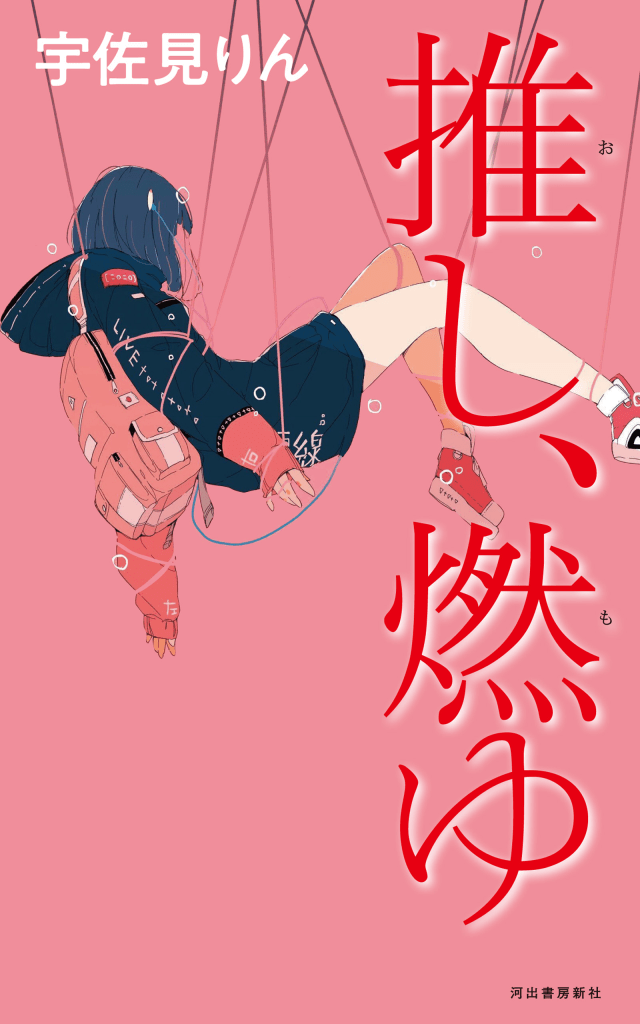
The trick for such an experience is to confront and make persona. People might say: it’s an escape. But I see it as a self-fashioning. As Akari declared, “This world where I showed up with my half-made-up persona was a kinder place.” She met people with same interest, passion, and affection. She was no longer alone, a quiet student having hard time at school and home. For some, this scene can be a little bit disorienting, because the “online” kindness (or even aggression) does not always match with the “offline timidity” and social disassociation. But, again, I truly understand the power of anonymity/pseudonymity. It gives you a degree of confidence — the real me is ugly so I’m gonna make a new self, an ideal one that fits with my preference. If we empathize with Akari, her aspiration is coming from a desperate and hopeful place, that a new day is possible, a new better self is not just a dream.
Such a trick gets trickier because the whole industry capitalized the sufferings of loneliness and the seduction of affection. The foundation is not less genuine but it’s nonetheless shaky. Once it cracks, we question our whole existence and purpose of living. Akari relied on her oshi for emotional support, as she doesn’t get it from her family and friends, but once her support turned into something that can no longer provide, her foundation is destroyed.
I’d lived with my oshi’s shadow on me for so long, always carrying double the breath, double the body heat, double the yearning. […] I’d been burdened by the weight of the flesh of my body ever since I’d been born. Now, I wanted to heed its trembling and destroy myself. I wanted to do it myself, instead of letting it happen to me.
I read this part in heavy breathing too. I understand her so much that her voice echoes as my own. To recognize this “cruelty of the flaming” passion between idols and fans is a difficult task. Because at the end of the days, we still want to believe that what we feel is not a self-destruction machine. We want to believe that our feeling can repair something broken within us.
I closed this novel with a relief. The ending is, at least, a bit of closure, even when that closure is not necessarily a celebration of “breaking free.”
I started picking up the cotton swabs. On my knees, head down, as carefully as if I were gathering the bones out of somebody’s ashes, I picked up the cotton swabs I had cast on the floor. Once I’d retrieved them all, I’d still need to clean up the moldy old rice balls, and the empty bottles of Coke, but now I could see the long, long road ahead.
Crawling on my hands and knees, I knew I’d found a way to keep living.
Trying to stand on my own two feet hadn’t worked out, but I could go forward like this for now. My body felt heavy. I picked up a cotton swab.
I like so much how Usami makes this last scene: picking up cotton swabs by crawling. Being independent, emotionally, might not always work out but at least Akari will try again.
As you’ve seen, the novel pushes forward my position about fandom. I was once an Akari who saw their idol — their emotional support disappeared in a flash, and they tried to stand on their own feet and moved forward through the whole decade of being 20s. Tough years. Heavy hours. I thought things would get smooth after I found a bit of self-confidence. It was a false assumption. Nevertheless, I’ve arrived at a point where I can embrace all bad and good things in my life. I just want to be a better adult. And so I walk this path and decided that being part of the fandom is not to rely emotionally on my idols but to grow together with them and apart from them. To enjoy their art, to exchange feelings, but also to make distance. This is why I’m moved with the last BTS Festa dinner in 2022 and becoming an ARMY only after they announced their hiatus as a group. Their music gives me joy; and their openness about what they want and their “rich artists” problem allow me to be honest with my privilege and what I want too (yes, i wanna be rich and a topdog). My idols will come back as a group in 2025, and I will welcome them with an open hand as a friend-in-transaction; we will burn each other with passion.
 Nik Setiadarma