How to make fun of a giant conference that is understood by later historians as one of the keys to the Third-World solidarity? This question sounds like an internet trolling, and perhaps serious historians might think it’s not worth for attention. It might be true but this question came after reading a stack of literature about Afro-Asian/Bandung Conference. Many of them are great and have contributed to the rich body of knowledge. Nonetheless, I have huge curiosity about the narrative of AA Conference that is not “too serious,” as I believe jokes and satire are a great form of writings that can give us a plot twist. And Star Weekly magazine gives use a fragment of answer.
Star Weekly (1946-1960) was a weekly magazine published in Jakarta by Keng Po, the popular daily newspaper among peranakan Chinese in Indonesia. Auwjong Peng Koen, or known as well as P. K. Ojong, was the editorial chief of the magazine with his vice, Tan Hian Lay. Every Saturday, this magazine offered news, opinions, and feature articles to their readers. If we are familiar with humorous and sardonic style of some Sino-Malay writings, we can see similar style in this magazine. Some writings were sarcastically hilarious, they make me chuckled in irony.
AA Conference was not missed from their criticism. In the edition No. 485, 16 April 1955, under the column “Pemandangan Dalam Negeri” (Domestic View), the editorial team wrote:
“On the 18th this month, Asia-African Conference will be held in Bandung and ministers also government staffs look very busy, as if someone is doing a little ‘mobilization.‘
Whereas in other countries, which are accustomed in organizing international conferences, such preparations go smoothly, quietly, less hassle and do not trouble the public.”
The article continued with a warning for readers to not expect too much from the conference, so they would not get disappointed. With the competition between USSR and the US, each country brought their own agenda and alliance, and the editorial team was skeptical the conference would change anything. “It is difficult to expect unanimous resolutions from AA conference besides general and vague resolutions, for instance denounce imperialism and any form of colonialism, or nuclear disarmament, or hope for world peace, rejecting racial discrimination, etc. It was not that there was no values in these announcements but they did not necessarily offer pratical and real actions.”
Near the end of the writing, the editorial team criticized this kind of giant conference or rapat-rapat samudera (lit: oceanic meetings).
“[These meetings] are not a sign of democratic spirit. …. The bigger the meetings, the more powerless those people who listened to the speeches to use their own mind and consideration. The individual mind in these giant meetings is swiped away by the flood of sentiments of hundred-thousands of people.”
Star Weekly accused these meetings as propagandic event to influence mass-psychology which had a risky tendecy that leading to extremism, fascism, and dictatorship.
“Giant meetings can bring wide popularity but it is unsustainable and shallow.”
This initial criticism continued on the next page. The column “Gambang Kromong” gave two short jokey anecdotes about the Conference. One of them quipped the exaggeration of AA Conference.
“Now everyone in Bandung are in A-A nuance. Even gas station is branded A-A number something. There are already 20 flag poles in the front of Concordia. And as a suggestion, our great leaders should provide oils for the neck, so they don’t get cramps from too much nodding to 28 foreign ministers.”
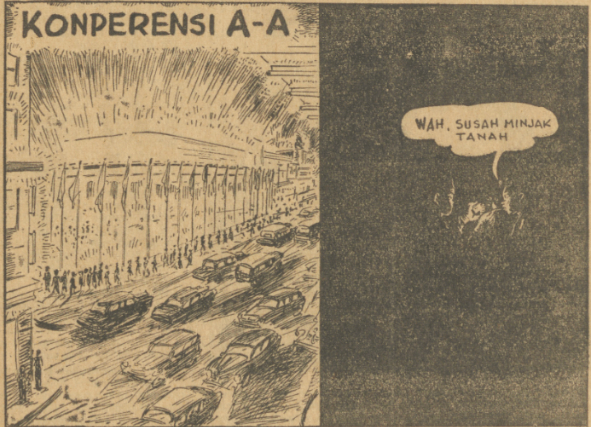
A week later, in the edition no. 486, 23 April 1955, the editorial team wrote about the fresh wind of AA Conference. Tired of many unpleasant news about domestic economy and politics, AA Conference seemed to bring fresh hope, although these possibilities were uncertain. The editorial team also discussed colonialism and racism, which became the topic of discussion in the Conference. And they reminded the readers that racism also happened in Indonesia. This included the ways former ministers treated “orang asli” and “bukan asli.”
The “Gambang Kromong” in this edition was now full about AA Conference. These anecdotes made fun of the luxurious cars provided by the government. The story started with a friend who was unlucky because he couldn’t use his new car because the government asked for it. After this car was “A.A.nized” the government would return it with compensation. Aside from that, the government also purchased dozens of luxurious cars. Rumour said that after the conference, these cars would be sold to people who did service for the conference; in other words, to the “internal person.”
“So, after these cars were A-A-nized, they would be sold in A-A-way too, which is between A(wak) with A(wak) or A(ku) with A(ku) (you and you, me with me).”
“Ja, what do Nasser and U Nu think [about these luxurious cars]. Perhaps: after seeing these super de luxe luxurious cars in A.A, no need to visit the US.”
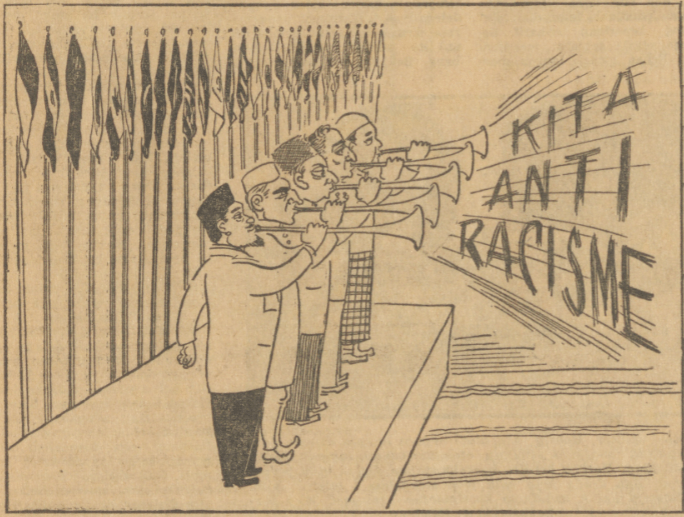
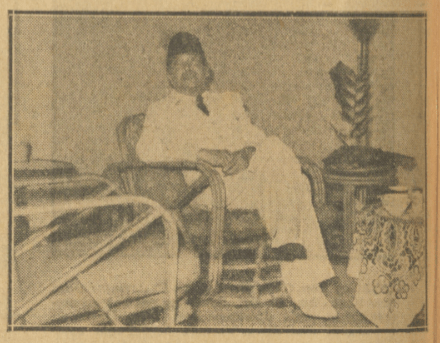
Aside from the jokey attitude, the magazine did proper report about the conference. Interestingly, it also provided a glimpse of ordinary scenes, such as a woman who told a journalist that people brushed the streets in Homann and Preanger street. “A brushed street. Too bad, after the brushing, there is no carpet.” There was also a story about a journalist who was not allowed to enter the conference room, or how the writer observed Sukarno who looked exhausted and had a little fever. A more “serious” writing appeared when the magazine discussed the economic impact of the conference.
This exposure about AA Conference in Star Weekly allows us to think about the conference in quite different way. It shows the humorous, critical element toward not only the conference but also Indonesian diplomatic scene. More research to be done, more archival resources to be read.
Sources:
Star Weekly, No. 485, 16 April 1955.
Star Weekly, No. 486, 23 April 1955.
 Nik Setiadarma